Why a single WiFi router isn't enough
A home router that works perfectly in a 60 m² apartment completely fails in a 200 m² office space. The reason is simple: signal weakens with distance and through walls, and business premises are often irregular in shape, with many walls and doors.
Add 15–20 devices simultaneously in use — computers, laptops, phones, printers, IP cameras — and you have a network that barely functions under the best conditions, and completely fails when it matters most.
The symptoms are familiar: slow internet at one end of the space, frequent disconnections, uneven signal, inability to video conference without plugging in a cable.

What is Mesh WiFi and how does it work?
A Mesh WiFi system consists of multiple devices (nodes) working together as a single network. Unlike traditional routers that only extend signal to a certain point, Mesh nodes communicate with each other and automatically direct devices to the nearest node with the strongest signal.
From the user's perspective: you walk around the office with a laptop or phone, and the network automatically switches between nodes without ever losing the connection or noticing a drop.
Benefits of Mesh WiFi for business premises
- Single network — one SSID (network name) for the entire space, no need to manually switch between "WiFi-1" and "WiFi-2".
- Automatic roaming — devices automatically switch to the nearest node without dropping the connection.
- Centralized management — everything is configured through one app or web console.
- Easy expansion — adding a new node takes just a few minutes.
Mesh vs. professional access points
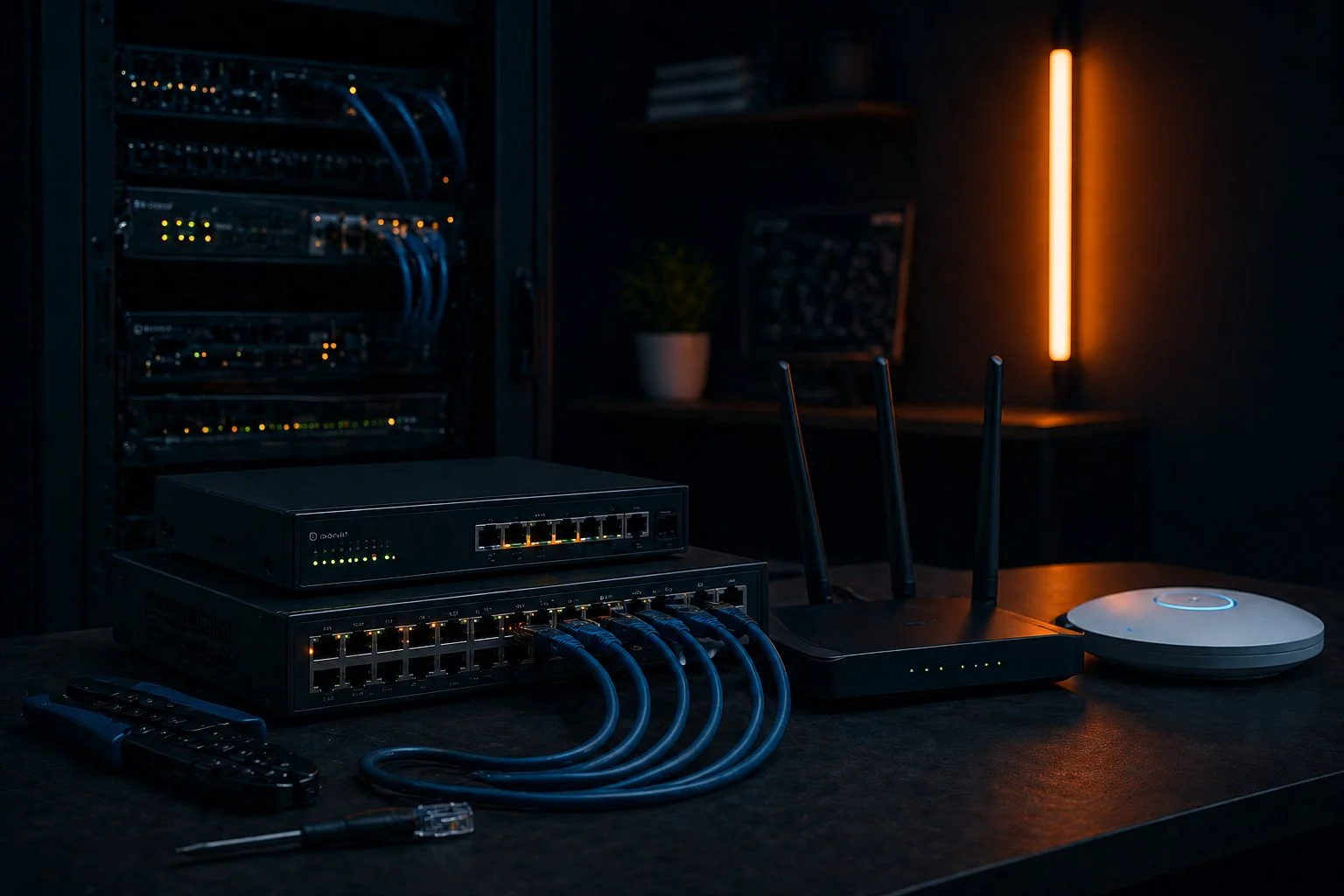
For business premises there are two approaches: consumer Mesh systems (Google Nest, Eero, TP-Link Deco) and professional WiFi systems with access points (Ubiquiti UniFi, Cisco Meraki).
| Feature | Mesh (consumer) | Professional access points |
|---|---|---|
| System cost | 150 – 500 EUR | 300 – 1,500+ EUR |
| Setup complexity | Low | Medium to high |
| Simultaneous users | Up to ~30 | 50–200+ |
| VLAN support | Limited | Yes (full) |
| Guest network | Yes | Yes (more advanced) |
| Recommended for | 5–25 users | 15–200+ users |
Our recommendation for most offices: For spaces up to 200 m² with 10–25 users, a quality Mesh system is ideal. For larger spaces or companies with more advanced network requirements (VLAN segmentation, guest WiFi isolated from the business network), we recommend the Ubiquiti UniFi system.
Conclusion
Poor WiFi in an office isn't a minor issue — it directly affects every employee's productivity and leaves a bad impression on visiting clients. A good network is an investment that pays off from day one.
If you're having WiFi coverage problems or the office internet connection is unstable, call us. We'll visit, measure the signal, and propose a solution that fits your space and budget.